TP4057 Li-ion Charging & Protection Board (Type-C, 5-Pack)
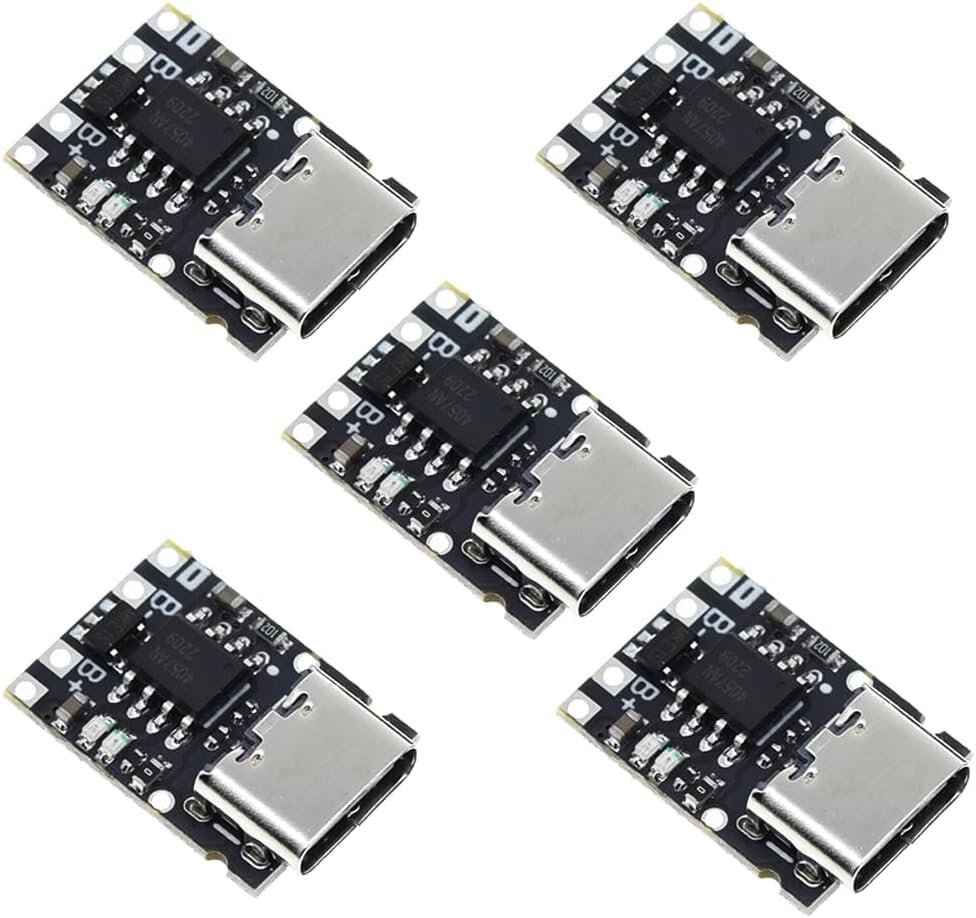
Overview
A small single-cell Li-ion charge board built around the TP4057 charge-management IC, with USB-C input and separate battery (B+/B-) and load (OUT+/OUT-) pads — meaning it can charge a cell and pass regulated output to a load at the same time (a “charging and discharging board,” per the label, as opposed to a bare charge-only board). No boost converter/inductor is present on this specific board (confirmed from the photo) — output is a straight pass-through from the battery, not stepped up to 5V, so downstream 5V-expecting loads still need their own boost stage.
Key specs
- Charge IC: TP4057 — single-cell Li-Ion linear charger, CC/CV profile, 4.2V termination voltage, charge current up to 1A (set internally/by an external resistor depending on board revision)
- Charge termination: automatic, cuts off around C/10 (1/10 of programmed charge current)
- Built-in reverse-polarity and reverse-charge protection (no external isolation diode needed) — per TP4057 datasheet
- Thermal regulation: reduces charge current automatically under high die temperature / high ambient temperature
- Input: USB-C, 4.0–8.0V per the IC’s supply range (typically just USB 5V in practice)
- No boost conversion —
OUT+/OUT-tracks battery voltage directly, not a fixed 5V
Pinout
| Pad | Function |
|---|---|
| USB-C | Charging input (5V typical) |
| B+ | Battery positive |
| B- | Battery negative |
| OUT+ | Load output positive (tracks battery voltage) |
| OUT- | Load output negative |
Wiring / typical usage
Connect a single-cell Li-ion/LiPo battery to B+/B- (e.g. one of the -99BATT 503035 cells or the NXD 103450 also in this library), plug USB-C into any 5V source to charge, and draw power for a project from OUT+/OUT-. Since there’s no boost stage, whatever the battery’s instantaneous voltage is (roughly 3.0–4.2V across a charge cycle) is what the load sees — fine for a 3.3V-tolerant MCU with its own onboard regulator, not a substitute for a stable 5V rail.
Code / libraries
N/A — passive charge/power hardware, no firmware interface.
Source material
- Bag label (item description, manufacturer, TP4057 part identity) read directly from the supplied photo.
- TP4057 IC behavior (CC/CV profile, 4.2V termination, protection features, thermal regulation): TP4057 datasheet — Digi-Key mirror
- Confirmed no onboard boost inductor by direct photo inspection of two unbagged units — cross-referencing common TP4057 module photos online turned up a visually similar but functionally different boost-output variant (same IC, adds an inductor for a fixed 5V output) sold under similar listing titles; this owned unit is the plain (non-boost) version, verified by the absence of an inductor in the supplied photo.
- Product photo:
/inventory/tp4057-charging-protection-board/product-photo.jpg— the actual owned unit (cropped from the supplied photo, bothB+/B-andOUT+/OUT-pads legible). - Local files: see
/inventory/tp4057-charging-protection-board/as-supplied.jpeg(bag label + two unbagged boards)
Verification
Bag label and board identity read directly from the supplied photo — high confidence. TP4057 IC behavior sourced from an official-mirror datasheet — high confidence on the chip itself. Whether this exact board’s protection circuitry (over-discharge/over-current on the OUT+/OUT- side) uses a separate protection IC or relies solely on the TP4057’s charge-side protection is NOT confirmed — the small secondary IC visible near the pads in the photo was not identified by chip marking. Treat over-discharge protection as unconfirmed until the second chip is identified, and don't assume the OUT+/OUT- side is protected against deep-discharge without checking.
Notes / gotchas
- Not a boost board — confirmed no inductor on this unit. If a project needs a stable 5V output regardless of battery charge state, this board alone won’t provide it; add a separate boost converter (e.g. the Dorhea MT3608 already in this library) downstream of
OUT+/OUT-. - A visually near-identical listing (same “TP4057… Type-C… Protection” title) sold online turned out to be the boost variant with an inductor — don’t assume a board photo found online for this part number matches this exact non-boost unit without checking for the inductor.