-99BATT 503035 LiPo Battery (3.7V 500mAh)
Overview
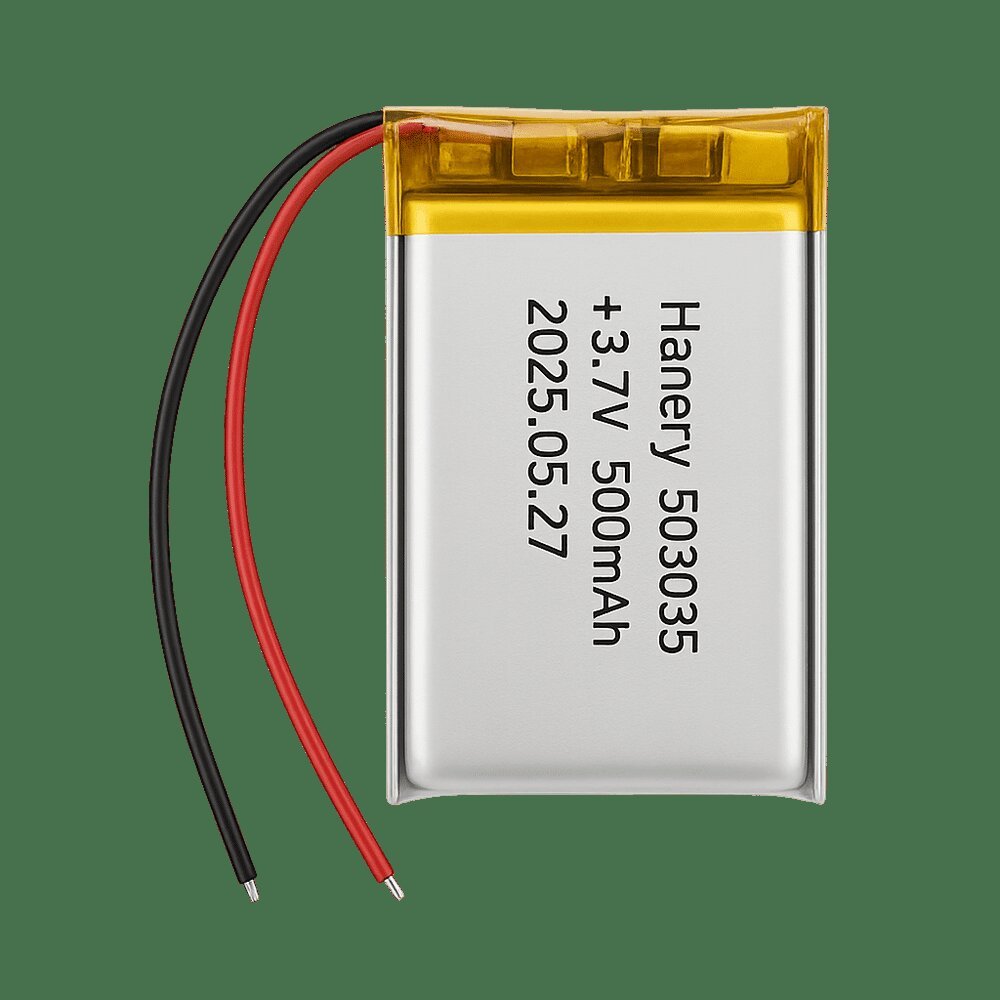
A single-cell lithium polymer pouch battery in the “503035” size-code form factor (see Key specs). Printed figures are internally consistent (3.7V × 500mAh = 1.85Wh exactly), a good sign the label is accurate. Each cell is pre-terminated with a small 2-pin JST-style pigtail connector (red/black leads), ready to plug into a charge board like the TP4057 board also newly added to this library, or a host MCU’s onboard battery input.
Key specs
- Nominal voltage: 3.7V (printed on cell)
- Capacity: 500mAh / 1.85Wh (printed on cell)
- Size code
503035: standard LiPo pouch-cell numbering = 5.0mm thick × 30mm wide × 35mm long - Lot/batch code:
EF02XY(printed on cell, not decoded further) - Charging: not printed on the cell itself — standard single-cell LiPo assumptions apply (4.2V max charge voltage, terminate via a proper charge IC like TP4057/TP4056) until/unless confirmed otherwise
- Connector: small 2-pin JST-style pigtail, red(+)/black(−) leads (pitch not confirmed — see Notes)
Pinout
| Wire | Function |
|---|---|
| Red | + (positive) |
| Black | − (negative/GND) |
Wiring / typical usage
Never wire a raw LiPo cell directly to a GPIO or an unregulated rail. Charge and discharge through a proper single-cell Li-ion management circuit — the TP4057 charging/protection boards documented alongside this battery are a natural pairing (same intake batch, likely bought together for exactly this purpose). If used with a board that has its own onboard battery management (Heltec V4, T-Display), confirm the connector pitch matches before assuming a direct plug-in.
Code / libraries
N/A — passive power source. Monitor charge level via whatever host board ADC/fuel-gauge circuit is available (e.g. the T-Display’s GPIO34/GPIO14 battery-read pins or the Heltec V4’s equivalent).
Source material
- Electrical specs (voltage, capacity, energy, size code, lot code) read directly from the cells’ own printed labels (photo-verified across both supplied bags) — high confidence, most authoritative source available for a pack-assembler-marked cell with no public datasheet.
- Size-code-to-dimension convention (503035 = 5.0×30×35mm) cross-referenced against the same convention already used for the NXD 103450 entry (103450 = 10×34×50mm) — consistent LiPo pouch-cell naming standard across manufacturers.
- Product photo:
/inventory/99batt-503035-lipo-3.7v-500mah/product-photo.jpg— the actual owned units (multiple cells visible across both supplied bags, labels legible). - Local files: see
/inventory/99batt-503035-lipo-3.7v-500mah/as-supplied.jpeg
Verification
Electrical specs read directly from the cells' own printed labels across multiple units — high confidence. Charge voltage limit and connector pitch are Inferred from standard single-cell LiPo convention (4.2V max charge) and visual inspection only — not printed on the cell or confirmed by test-fit against any specific host board's connector. Confirm connector pitch (likely JST-PH 2.0mm or JST-SH 1.25mm) by physical test-fit before assuming compatibility with any specific charge board or MCU battery input.
Notes / gotchas
- Quantity (10) per Alex’s count, not independently verified by counting cells in the photo — some cells are stacked/overlapping in the supplied bags and not all individually visible. Update this if a physical recount finds a different number.
- No visible protection PCB/PCM on any cell in the supplied photo — same caution as the NXD 103450 entry: charge only through a proper charge/protection circuit (e.g. the TP4057 boards above), don’t assume the cells are individually protected against over-discharge.
- Connector pitch not confirmed — verify before assuming interchangeability with the Heltec V4, T-Display, or any other board’s battery input in this library.
- Used in: Pocket Speaker — the connector-pitch question this flagged is sidestepped there: the pigtail gets cut and soldered directly (it has to feed two destinations anyway), rather than plugged in as-is.