Heltec L76K GNSS Module
Overview
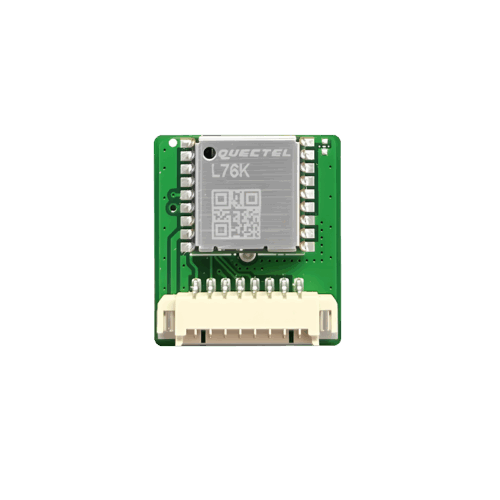
A small multi-constellation GNSS receiver (GPS + GLONASS + BeiDou + QZSS) built around the Quectel L76K chip, sold by Heltec as a purpose-made accessory for their WiFi LoRa 32 V4 and Mesh Node T114 boards. It ships with an onboard ceramic antenna and an 8-pin 1.25mm JST SH cable that plugs directly into the V4 board’s dedicated GNSS connector — no breadboarding needed, it’s a keyed drop-in match. Commonly used for Meshtastic/MeshCore position-tracking nodes.
Key specs
- Operating voltage: 2.8V–4.3V
- Logic level: 3.3V (matches ESP32-S3 host directly)
- Current draw: ~18mA @ 3.3V (module spec, full-on tracking mode)
- Interfaces: UART (TXD/RXD), plus 1PPS timing output, WAKE_UP, RESET_N, and a backup/control power pin — all broken out on the 8-pin cable
- Position accuracy: 2.5m CEP
- Timing accuracy (1PPS): 10ns
- Update rate: up to 10Hz
- Operating temperature: -40°C to 85°C
- Dimensions: 10.1 × 9.7 × 2.5mm (bare module, per Heltec’s listing — note the datasheet’s IC-level dimension differs slightly from the finished breakout’s footprint)
Pinout
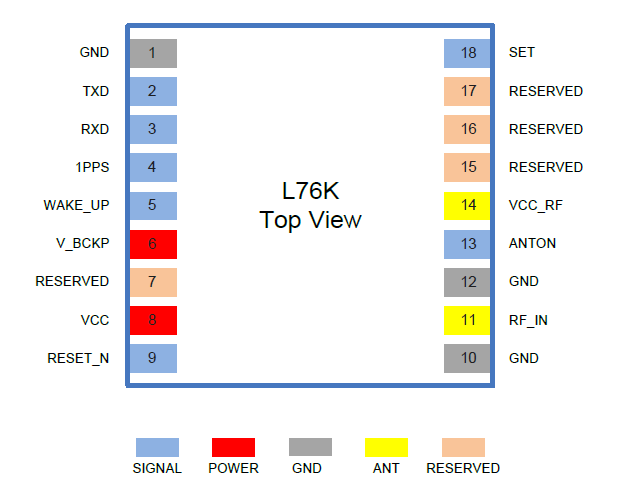
The Quectel L76K IC itself is an 18-pin part (full IC pinout saved at /inventory/quectel-l76k-gnss/l76k-ic-pinmap.png), but only the signals relevant to a host MCU are broken out on this breakout’s 8-pin cable. Heltec states this module is “fully compatible with WiFi LoRa 32 V4” — its 8 signals correspond 1:1 with the V4 board’s dedicated GNSS connector (see the Heltec V4 README):
| Signal (module) | Matches V4 GNSS connector pin | Function |
|---|---|---|
| GND | GND | Ground |
| VCC | 3V3 | 3.3V power |
| TXD | GPIO39 (GNSS_TX) | GNSS module → host UART data |
| RXD | GPIO38 (GNSS_RX) | Host → GNSS module UART data |
| WAKE_UP | GPIO40 (GNSS_Wake) | Wake from standby |
| 1PPS | GPIO41 (GNSS_PPS) | 1 Hz timing pulse, valid once locked |
| RESET_N | GPIO42 (GNSS_RST) | Active-low reset |
| SET / power control | GPIO34 (VGNSS_Ctrl) | Module power enable (host-side control of module VCC) |
Wire colors as supplied on this exact cable (photographed, physical left-to-right order in the connector housing): red, black, yellow, green, blue, white, orange, brown.
Wiring / typical usage
Designed to plug straight into the Heltec WiFi LoRa 32 V4’s 8-pin GNSS JST connector — that’s the entire wiring job for that pairing. For any other host, wire GND/VCC to power, TXD/RXD to a host UART (cross them: module TXD → host RX), and treat WAKE_UP/1PPS/RESET_N/SET as optional GPIOs (a basic NMEA read only strictly needs GND, VCC, TXD, RXD).
Code / libraries
- Standard GPS/GNSS NMEA libraries apply — e.g.
TinyGPS++(Arduino) reading the TXD line over a hardware or software UART. - Meshtastic and MeshCore have native support for this exact module paired with the V4/T114 boards — if the end goal is a tracker node, check their board-specific GPS config rather than writing a parser from scratch.
- Default baud rate not confirmed locally — Quectel L76-series modules commonly default to 9600 baud NMEA output; verify before assuming.
Source material
- Product page: https://heltec.org/project/l76-gnss-module/
- IC pin map (raw Quectel L76K chip, not the cable): https://heltec.org/wp-content/uploads/2025/07/L76K_pinmap.png — saved locally at
/inventory/quectel-l76k-gnss/l76k-ic-pinmap.png - Dimension drawing: saved locally at
/inventory/quectel-l76k-gnss/l76k-dimensions.png - Datasheet reference: Quectel L76 GNSS Series Presentation V1.4 — https://resource.heltec.cn/download/Mesh_Node_T114/Quectel_L76_GNSS_Presentation_V1.4.pdf (not pulled locally)
- Product photo:
/inventory/quectel-l76k-gnss/product-photo.png— exact match, official Heltec product photo (module board only, cable sold/shown separately), sourced 2026-07-25 from https://heltec.org/wp-content/uploads/2025/07/L76K_B-500x500.png - Companion board:
components/mcu/heltec-wifi-lora-32-v4/— this module was bundled with each of the 4 V4 boards owned - Local files: see
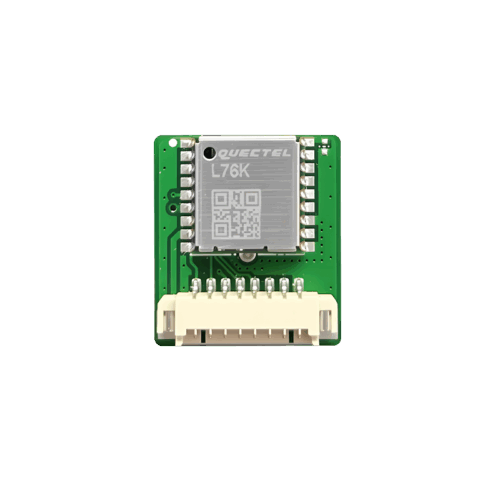
/inventory/quectel-l76k-gnss/module-connector.jpeg(as-supplied photo),/inventory/quectel-l76k-gnss/l76k-ic-pinmap.png,/inventory/quectel-l76k-gnss/l76k-dimensions.png
Verification
Chip identity (Quectel L76KB-A58) read directly off the chip’s own laser marking in the supplied photo, matched against Quectel/Heltec listings — high confidence. General specs (voltage, current, accuracy, update rate, interface type) Verified against Heltec's official L76K GNSS Module product page (heltec.org).
Signal-to-pin mapping is a medium-confidence inference, not directly verified: Heltec’s product page confirms this module is designed as a drop-in match for the V4’s GNSS connector, and the 8 module signals (GND/VCC/TXD/RXD/WAKE_UP/1PPS/RESET_N/SET) line up one-to-one with the V4 connector’s 8 documented signals — but no single Heltec source shows the cable’s wire-color-to-signal table directly. Wire colors above are recorded as-photographed only. Before wiring this to anything other than the matching V4 GNSS port (i.e. before assuming a specific wire color = a specific signal), confirm with a continuity check against the connector housing’s keying/pin-1 marking, or plug-and-test with the V4 board where the connector is physically keyed to only mate one way.
Notes / gotchas
- Physically keyed to the V4’s GNSS connector — for the intended pairing, there’s no ambiguity to resolve; the connector only mates one way.
- Onboard antenna is ceramic/passive — don’t expect great lock times or accuracy indoors; this is meant for outdoor tracker use.
- SET/power-control pin (VGNSS_Ctrl on the V4 side) suggests the host is expected to gate the module’s power for sleep/low-power designs — check the V4’s power-consumption table (sleep <20µA) before assuming the GNSS module is included in that figure; GNSS modules are rarely that low-power on their own.