Universal 4-Key Push Button Switch Module (Geeriu)
Overview
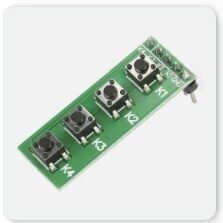
A small breakout board carrying 4 independent tactile push-button switches (labeled K1–K4), each brought out to its own pin header — a simple 4-button keypad for MCU/breadboard projects (menu navigation, direction pad, mode select, etc.). This exact “Universal 4 Key Push Button Switch Module” design is sold by dozens of resellers (Geeriu among them) under identical or near-identical board layouts.
Key specs
- 4 independent momentary tactile switches (K1–K4)
- Breadboard/pin-header compatible, through-hole
- Typical logic-level operation (3.3–5V) — not independently confirmed for this exact reseller’s board
- No onboard debounce, pull-ups, or debounce capacitors on most versions of this generic design (confirm against the physical board — some variants do add pull-down resistors per key)
Pinout
Exact silkscreen labeling not confirmed for the Geeriu-branded unit specifically, but the near-universal layout for this generic module is:
| Pin | Function |
|---|---|
| K1 | Switch 1 output |
| K2 | Switch 2 output |
| K3 | Switch 3 output |
| K4 | Switch 4 output |
| GND (or VCC, depending on variant) | Shared common rail for all 4 switches |
Some variants of this generic design wire the common rail to GND (switches pull the key pin low when pressed, needs an internal/external pull-up on the MCU side); others wire it to VCC (active-high, needs a pull-down). Confirm which variant this is against the physical board or a continuity check before wiring — this is the one detail that genuinely varies across “Universal 4 Key” resellers.
Wiring / typical usage
Connect the shared rail pin to GND or VCC (per the variant — see above), and each K1–K4 pin to its own GPIO with the appropriate pull-up/pull-down (internal MCU pull-up/pull-down is usually sufficient; some board variants include their own). Standard mechanical-switch debounce applies in firmware.
Code / libraries
N/A — passive switches, read as standard debounced digital inputs, one GPIO per key.
Source material
- Purchase context: Amazon, “Universal 4 Key Push Button Switch S…” — seller “Geeriu,” $6.98. The exact ASIN wasn’t captured from the order screenshot; multiple visually-identical “Universal 4 Key Push Button Switch Module” listings exist from different resellers (Hyuduo, generic “for MCU Breadboard” listings, etc.) at the same form factor.
- Product photo:
/inventory/generic-4key-button-module/product-photo.jpg— cropped directly from Alex’s own Amazon order-history thumbnail for this exact purchase (the listing’s own product image, not a stand-in — this is the actual Geeriu-branded board, K1-K4 silkscreen visible). Low resolution (thumbnail-sized) since it’s a cropped order-history screenshot rather than a full-size product photo.
Verification
Inferred from the generic "Universal 4 Key Push Button Switch Module" design shared across many Amazon/AliExpress resellers — NOT verified against the specific Geeriu-branded board. Confirm pin labeling (K1-K4) and common-rail polarity (GND vs. VCC) against the physical board, or a clear close-up photo, before wiring.
Notes / gotchas
- This is one of the least-verified entries in the library — the “Geeriu” branding on the actual purchase couldn’t be matched to a specific authoritative listing/datasheet. Treat every spec above as provisional until confirmed against the physical board.
- If the board turns out to share a design with an already-documented part (e.g. behaves identically to a known “4 key keypad module”), consider merging/cross-referencing rather than maintaining two near-duplicate entries.
- Used in: Pocket Speaker — all 4 keys: play/pause, volume up/down, on/pairing. The common-rail-polarity question flagged above isn’t resolved yet; the build sheet has it as a required continuity check before wiring, not a guess.