16x2 Character LCD with I2C Backpack ("1602IIC")
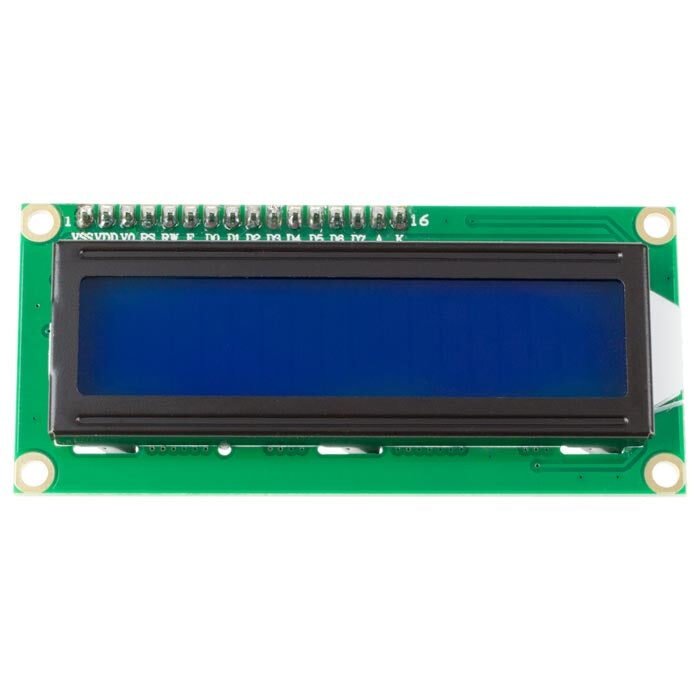
Overview
A standard 16-character × 2-line HD44780-compatible character LCD (negative white text on blue backlight) with an I2C “backpack” board soldered directly onto its 16-pin parallel header. The backpack converts the LCD’s native 16-pin parallel/4-bit interface down to a 4-wire I2C connection (GND, VDD, SDA, SCL), which is the near-universal way these displays are used today — bare 16-pin wiring is rarely worth the GPIO cost when this backpack exists. The LCD’s own controller is an epoxy-blob chip-on-board (COB) under the black blob on the rear — standard practice for these displays, no chip marking is physically visible or expected.
Key specs
- Operating voltage: 5V (per the common HD44780/PCF8574-backpack combination for this exact board family)
- Logic level: I2C bus runs at whatever the host provides — commonly 5V on these boards; check host compatibility if driving from a 3.3V-only MCU (may need a level shifter or a 3.3V-tolerant backpack variant, not confirmed which this is)
- Current draw: not confirmed for this specific board — comparable HD44780+backlight modules typically draw tens of mA (LCD logic) plus the backlight LED current; not measured
- Interfaces: I2C (2-wire, via backpack) — native 16-pin parallel interface is also present underneath the backpack if ever needed
- Display: 16 characters × 2 lines, 5×8 dot character cells, negative white on blue backlight
- I2C backpack chip:
HLF8574T— a PCF8574T-compatible I2C 8-bit I/O expander clone - Default I2C address: 0x27 — the A0/A1/A2 address-select solder pads on the backpack are unbridged (open), and per the PCF8574T addressing scheme (as opposed to the address-shifted PCF8574AT variant, which defaults to 0x3F), all-open pads default to 0x27
Pinout
16-pin LCD interface (native HD44780 parallel bus, pins 1–16 as silkscreened on the board, now covered by the backpack):
| Pin # | Name | Function |
|---|---|---|
| 1 | VSS | Ground |
| 2 | VDD | +5V logic power |
| 3 | V0 | Contrast adjust (driven by backpack’s onboard potentiometer) |
| 4 | RS | Register Select |
| 5 | RW | Read/Write |
| 6 | E | Enable (clock strobe) |
| 7 | D0 | Data bit 0 (unused in 4-bit mode) |
| 8 | D1 | Data bit 1 (unused in 4-bit mode) |
| 9 | D2 | Data bit 2 (unused in 4-bit mode) |
| 10 | D3 | Data bit 3 (unused in 4-bit mode) |
| 11 | D4 | Data bit 4 |
| 12 | D5 | Data bit 5 |
| 13 | D6 | Data bit 6 |
| 14 | D7 | Data bit 7 |
| 15 | A | Backlight LED anode (+) |
| 16 | K | Backlight LED cathode (GND) |
4-pin I2C backpack header (what actually gets wired, silkscreened 1–4 on the backpack board):
| Pin # | Name | Function |
|---|---|---|
| 1 | GND | Ground |
| 2 | VDD | +5V power |
| 3 | SDA | I2C data |
| 4 | SCL | I2C clock |
The backpack drives the 16-pin interface internally (4-bit mode: D4–D7 only, RS/RW/E, plus PWM/on-off control of the backlight transistor) — none of the 16 parallel pins need to be touched once the backpack is soldered on.
Wiring / typical usage
Four wires only: GND, VDD(5V), SDA, SCL to the host’s I2C bus (add pull-ups if the host doesn’t already have them — most MCU dev boards do). Adjust the onboard potentiometer (on the backpack) for contrast if the display shows blank or solid black boxes. Backlight is switchable in firmware via the library’s backlight()/noBacklight() calls (controlled through the PCF8574-compatible expander, not a separate wire).
Code / libraries
- Arduino:
LiquidCrystal_I2C(most common) or Frank de Brabander’s fork — construct with the address, e.g.LiquidCrystal_I2C lcd(0x27, 16, 2); - If 0x27 doesn’t respond, run a standard I2C scanner sketch before assuming the address is wrong — solder-bridge state can be misread from a photo, and cheap clones occasionally ship with unexpected defaults.
- ESP-IDF / MicroPython: any PCF8574-based I2C LCD driver library works — the
HLF8574Tclone is register-compatible with PCF8574T.
Source material
- Board self-identifies via silkscreen:
1602IIC - Backpack chip identity read directly from chip marking in supplied photo:
HLF8574T - General reference for this exact board family/wiring (HD44780 + PCF8574-type backpack, address scheme): Handson Technology I2C 1602 LCD user guide — https://www.handsontec.com/dataspecs/module/I2C_1602_LCD.pdf
- Address-scheme cross-reference: https://alselectro.wordpress.com/2016/05/12/serial-lcd-i2c-module-pcf8574/
- Product photo:
/inventory/1602-lcd-i2c-16x2/product-photo.jpg— exact form-factor match (blue backlight, 16-pin header, I2C backpack), sourced 2026-07-25 from https://www.addicore.com/cdn/shop/products/AD156-2.jpg - Local files: see
/inventory/1602-lcd-i2c-16x2/front-pinout.jpeg(16-pin LCD side, silkscreen pin labels),/inventory/1602-lcd-i2c-16x2/back-backpack-chip.jpeg(backpack board,HLF8574Tchip marking, A0/A1/A2 address pads)

Verification
Verified against physical chip marking (HLF8574T) and board silkscreen (1602IIC, full 16-pin labels, A0/A1/A2 pads) read directly from two supplied photos — high confidence on pinout and I2C address. The 0x27 default address is inferred from the PCF8574T addressing convention (open pads = 0x27) cross-referenced against Handson Technology’s documentation for the same board family; HLF8574T itself is a clone part with no official datasheet found, so its addressing is assumed identical to genuine PCF8574T (same pinout, same silkscreen conventions, same “T vs AT” naming pattern) rather than confirmed against its own datasheet. If 0x27 doesn’t respond on first try, run an I2C scanner before debugging further — cheap clone chips occasionally deviate.
Notes / gotchas
- LCD controller itself (under the epoxy blob, U1/U2/U3 on the back) is unmarked by design — this is normal for COB (chip-on-board) construction, not a gap in the intake process.
- If driving from a 3.3V-only host (e.g. an ESP32 or RP2350 board), verify the backpack and LCD tolerate 3.3V I2C signaling — these boards are most commonly designed around 5V and behavior on 3.3V logic isn’t confirmed for this unit.
- Contrast pot is easy to overlook — a “blank” display is almost always a contrast issue, not a wiring or address issue.